Tombola Talk: The Secret Dialect of the British Village Fête
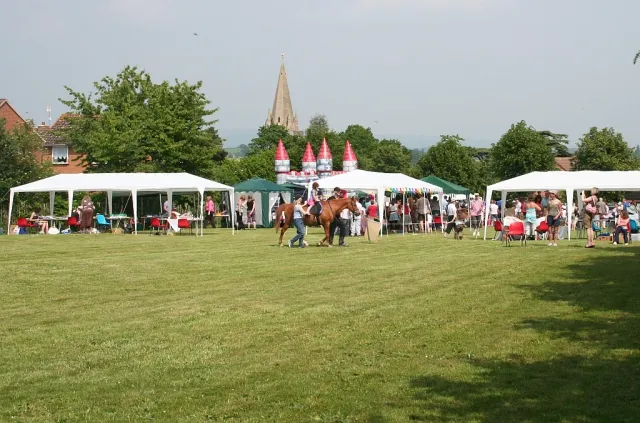
Photo: Bob Embleton, CC BY-SA 2.0, via Wikimedia Commons
There's a moment at every village fête when a newcomer betrays themselves. They take the second slice of Victoria sponge without hesitation. They ask what's in the tombola. They make direct eye contact at the jam stall. Small errors, certainly — but to the fluent speakers of Fête, they're the equivalent of ordering chips with a fork.
Because here's the thing we rarely admit: the great British village fête isn't just an event. It's a language. A fully functioning dialect, complete with its own vocabulary, grammar, registers and — crucially — a rich system of things you simply do not say.
The Vocabulary of the Cake Table
Start with the lexicon. 'Nearly homemade' is a phrase that does enormous work in about three words. It means the baker bought a supermarket sponge and decorated it, and everyone present understands this, and nobody will ever say so out loud. It's a euphemism so polite it's practically a curtsy.
Then there's the taxonomy of jams. 'Traditional' means the fruit content is a rumour. 'Award-winning' means it won something in 2011 at a show you've never heard of. 'Rustic' means the jars were filled in a hurry and the labels are handwritten, which — whisper it — is often a sign of the good stuff.
The tombola, meanwhile, has its own verb system. You don't 'win' at a tombola so much as you are 'called up', a phrase that carries the same quiet dread as being summoned to the headmaster's office. The prizes — a tin of peaches, a novelty mug, a bottle of something that is legally only allowed to be described as 'liqueur' — are accepted with a standard unit of gratitude, calibrated precisely: warm, but not effusive. Enthusiasm suggests you wanted the peaches. Nobody wants the peaches.
Grammar Is Gestures
Like any living language, Fête is carried as much by the body as the tongue. The second-helping queue at the cake stall operates on an unwritten syntax: you may join the back, but you must signal to the person ahead of you that you're aware they were there first, usually with a small nod or a 'go on then' directed at nobody in particular.
Silence, too, is load-bearing. The pause after someone compliments the bunting is not empty — it's a space where a reciprocal compliment is expected. Ignore it and you've committed a pragmatic error no dictionary would flag.
Even the weather talk is different here. At a fête, 'lovely for it, isn't it?' isn't small talk. It's a greeting, a blessing and a status report all in one, and the correct response is neither agreement nor disagreement but a contented sigh that acknowledges the fragility of the whole enterprise.
Who Gets to Be Fluent?
Like most dialects, Fête is learned, not inherited — which is exactly why it can feel exclusionary. Turn up to a WI meeting or a church coffee morning as an outsider and the codes are everywhere: who makes the tea (there is a hierarchy), where you sit (there is geography), when it's appropriate to leave (there is a window, and it is narrow).
But here's the hopeful part. These gatherings are also remarkably efficient integration machines. Offer to wash up, and you've said more about yourself than an hour of introductions could. Bring something to the cake table — even something nearly homemade — and you've submitted your application for fluency. The dialect wants new speakers. It just requires you to do a bit of listening first.
A Grammar at Risk
Which brings us to the uncomfortable question. Village fêtes are fading — squeezed by village hall closures, ageing committees and a general national amnesia about how to run a raffle. And when a fête goes, it doesn't just take the tombola with it. It takes the grammar.
Because what these gatherings really are is practice: rehearsal rooms for community. The fête is where a village learns how to ask for help, how to accept a compliment, how to queue, how to disagree about prize categories without anyone raising their voice. Lose the venue and you lose the vocabulary.
The good news is that dialects are resilient. Every school summer fair, every allotment open day, every bring-a-plate situation is Fête adapting to new ground. The medium changes — WhatsApp groups instead of parish notices, contactless donation buckets instead of jam jars of coins — but the underlying language, the one spoken in nods and pauses and perfectly calibrated gratitude, endures.
So go. Find your local fête. Learn the phrases. Accept the peaches with dignity. Because every dialect dies when its speakers stop bothering — and this one, at least, is worth keeping alive.