Sorry Seems to Be the Hardest Easiest Word: How Britain Perfected the Art of Apologising in Ten Languages
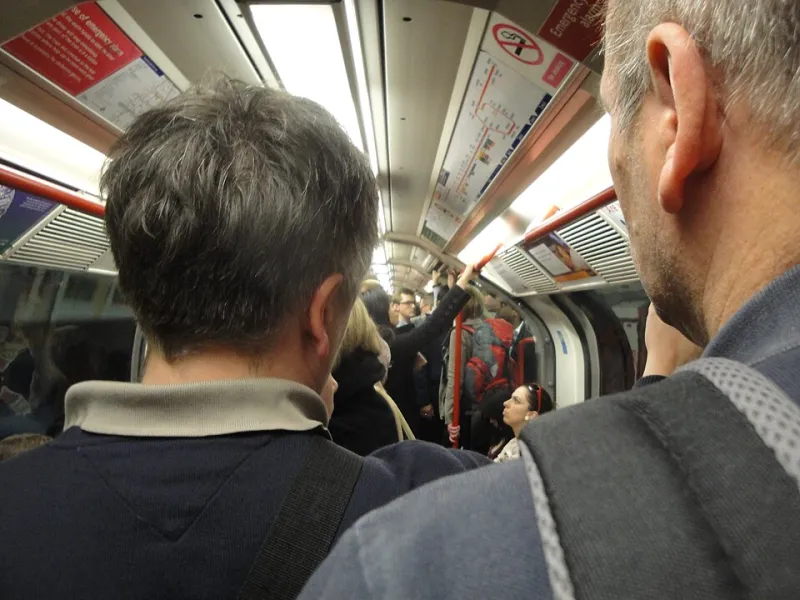
Photo: Editor5807, CC BY-SA 3.0, via Wikimedia Commons
There's a particular kind of magic that happens on a crowded Northern Line carriage. Someone treads on your toe. You — the injured party — look them dead in the eye and say, with total sincerity: 'Sorry.' They say it back. Nobody means it. Everybody understands it perfectly.
If you've just moved to the UK, this ritual can be baffling. To help decode it, we spoke to people from ten different language backgrounds now living across Britain — from Glasgow to Cardiff to a very rainy corner of Manchester — and asked them one question: what did the British apology look like through your eyes?
Sorry, But We're Going to Talk About Sorry
Let's start with the numbers, loosely counted by anyone who's ever queued in a post office. Linguists have noted that British English speakers use 'sorry' at rates that would exhaust speakers of most other languages. It's a greeting, a buffer, a complaint, a full stop. 'Sorry — could I just — sorry' is, technically, a complete sentence in British.
But here's the twist: the British 'sorry' often isn't an apology at all. It's a social lubricant, a way of acknowledging that two humans have briefly collided in space. Sociolinguists call it a 'phatic expression' — language that does a job rather than carries a meaning. Like a handshake made of vowels.
Sumimasen and the Art of the Useful Apology
Yuki, a designer who moved from Osaka to Leeds three years ago, spotted the parallel immediately. 'In Japanese we say sumimasen all the time — it means sorry, thank you, excuse me, all at once. When I heard British people saying sorry for things that weren't their fault, I thought: ah, this is my language too.'
Sumimasen is famously slippery. Thank a Japanese shopkeeper and they may respond with it — 'sorry (for the trouble of) serving you'. Yuki's theory? Britain and Japan, two island nations with a taste for understatement and a horror of making a scene, independently evolved the same linguistic survival kit.
Hnaan, Ta'assof, and the Weight of Meaning
Not every language treats apology so lightly. Amira, a doctor from Cairo now working in Birmingham, explained that Arabic offers hnaan — a word carrying connotations of gentleness and forgiveness-seeking — alongside the more formal 'itidaar. 'In Arabic, an apology is a real transaction. It restores something. When I first heard a British colleague say sorry three times in one email about a scheduling mix-up, I thought something terrible had happened.'
Similarly, Marta from Warsaw noted that Polish przepraszam — literally 'I ask to be released from blame' — feels like signing a small legal document each time. 'You would not say it because someone bumped into you. Never.'
The Non-Apology Apology: A National Art Form
And then there's the apex of British apologetic culture: the non-apology apology. You know the genre. 'We apologise for any inconvenience caused.' 'If anyone was offended, we're sorry.' 'Mistakes were made.'
It's a construction that apologises to a phantom audience for an unnamed act committed by no one in particular. Politicians have perfected it. Corporates have industrialised it. A rail company once apologised for trains being 'too crowded' — not for running no trains, you understand, but for the crowd itself existing.
Compare that with the Fijian loloma or the elaborate apology ceremonies of various cultures worldwide, where saying sorry involves actual restitution. The British version, by contrast, is designed to close a conversation, not open a wound. It's a linguistic fire door: it keeps things moving.
What Newcomers Teach Us About Ourselves
Every person we spoke to eventually learned the code — and most came to love it. Kwame, a teacher from Accra now in Croydon, put it best: 'In Twi, we say kafra — it's serious, it's from the heart. British sorry is more like breathing. But I realised it's not empty. It's a way of saying: I see you, I don't want conflict, let's both be okay. That's quite beautiful, actually.'
Perhaps that's the real story. Behind the reflex, the overuse, the comedy of two people saying sorry to each other in a doorway for eleven seconds — there's a philosophy. The British apology isn't about guilt. It's about keeping the peace, softening the edges of a crowded island, and ensuring nobody ever has to feel awkward alone.
Sorry if that sounds sentimental. Old habits.