Half-Time in Five Languages: The Sunday League Pitch Where Britain Learns to Talk
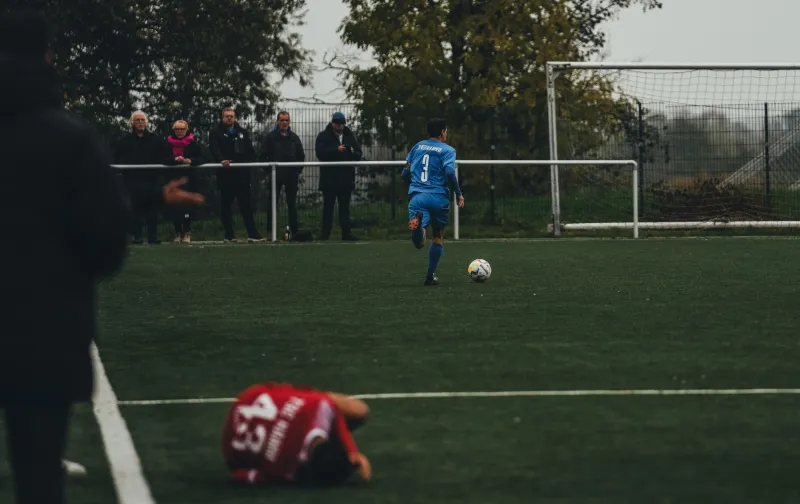
There's a moment, somewhere around the seventy-minute mark of most Sunday league matches, when the game stops being a game and becomes a negotiation. A defender in a faded yellow kit shouts something that sounds like a threat but is probably tactical advice. His centre-back, who moved here from Bucharest three years ago, answers in Romanian. The referee — who learned his football in a small town outside Kraków — blows his whistle and settles the dispute in English with a Polish accent. Everyone nods. Play resumes.
Nobody at this level calls it a language exchange. But that's exactly what it is.
The Touchline Is a Translation Service
Spend a few weekends at any grassroots ground in Britain — the Hackney Marshes, a bobbly park pitch in Sheffield, a school field in Luton — and you'll hear more languages than you would in a term of evening classes. Polish managers barking instructions. Portuguese and Brazilian wingers swapping banter mid-run. Cantonese-speaking grandparents offering tactical verdicts from behind the goal, loudly and correctly.
Take Sunday league in East London. One team might field a Nigerian goalkeeper, two brothers from Kosovo, a Scottish centre-half who learned football vocabulary entirely from Match of the Day, and a striker from São Paulo who now says "man on" with a London twang. The instructions flow in four or five languages, and somehow — remarkably — the offside trap still works.
Football, it turns out, is a brilliant teacher because it doesn't care about grammar. It cares about now. You learn "switch!" because if you don't, the winger doesn't get the ball and everyone groans. Motivation, as any language teacher will tell you, is ninety per cent of the battle.
Borrowed Boots, Borrowed Words
The vocabulary of British football has always been a magpie's nest. We took "blitz" from German, "total football" from the Dutch, and "tiki-taka" from Spanish commentators. But the borrowing now runs the other way too, and much faster.
At grassroots level, English football slang is being exported and remixed at speed. Polish players on UK pitches say "guttered" and mean it sincerely. Portuguese youngsters have adopted "get stuck in" as a complete philosophy. Meanwhile, British-born players with grandparents from Lagos or Lahore are quietly folding Yoruba and Punjabi celebrations into post-goal rituals that their teammates copy without ever asking what they mean.
A coach I spoke to in Bradford — a former semi-pro who now runs an under-14s side — put it beautifully: "The kids don't learn Urdu from me. They learn it from each other, one swear word and one celebration at a time. By February they all celebrate like my mum does."
The Grandparents' Section
Here's the part nobody documents: the touchline elders. In communities across Britain, football is one of the few places where three generations share a physical space weekly. The grandparents often speak limited English; the grandchildren often speak limited heritage language. The match is the middle ground.
A grandmother shouting "快啲啦!" ("faster!") at her grandson is teaching him more than vocabulary — she's teaching him that his grandmother's language belongs on a pitch in Rotherham as much as anywhere. The kids pick up phrases the way they pick up stepovers: through repetition, need, and joy.
And it flows both ways. Coaches describe learning basic phrases — a greeting in Romanian, "well played" in Polish — not from courses, but from wanting to say something kind to a parent at full-time.
Why the Pitch Beats the Classroom
Linguists have a term for this: situated learning. You absorb language when it's attached to something you desperately want — a goal, a win, a place in the team. There are no flashcards on a wet Tuesday in Rochdale. There is only "mark your man" and the urgent human need to be understood.
Compare that to a language app. The app will teach you to say "the library is next to the station." The pitch will teach you to shout "leave it!" in a way that saves a goal. One of these is useful on a Sunday morning.
There's something else, too. Football gives newcomers a role before they have fluent language. You can be the best player on the team while your English is still a work in progress — and suddenly the English kids want to talk to you. Status on the pitch translates into confidence off it.
Full-Time Whistle
Council pitches don't make the news. There's no funding line for "informal multilingual community integration through sport." But every weekend, thousands of matches across Britain quietly perform one of the great unsung feats of language teaching — no syllabus, no fees, just eleven-a-side and the universal grammar of shouting "time!" when a ball's rolling towards the touchline.
So next Sunday, if you pass a muddy park and hear a dozen tongues arguing about a handball, listen closer. That's not noise. That's Britain talking to itself — and getting better at it, one match at a time.