The A-Road Is an Archive: Ten UK Place Names That Are Really Frozen Sentences
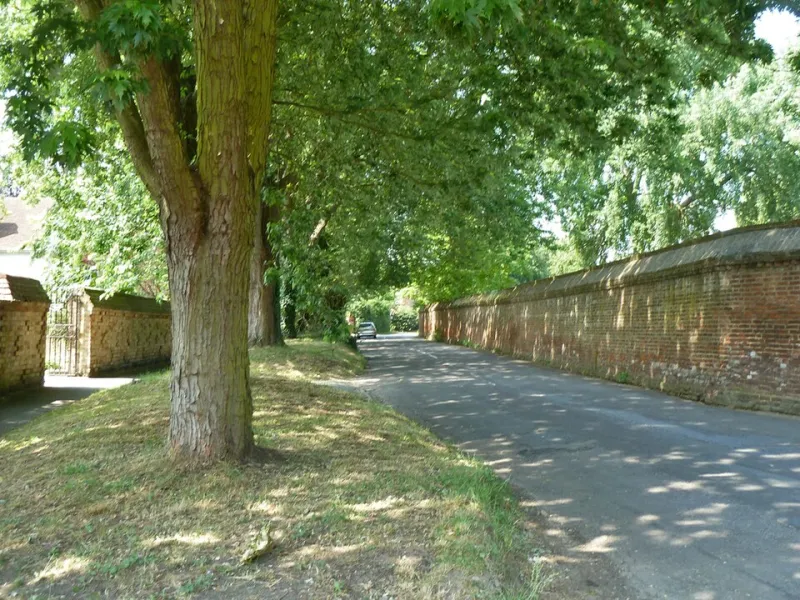
Photo: Robin Webster , CC BY-SA 2.0, via Wikimedia Commons
Every road trip in Britain is a lecture in dead grammar, and most of us sleep through it. But look at the signs properly — really look — and you'll realise each one is a sentence that's been frozen mid-speech for centuries. Norse, Old English, Welsh, Gaelic, Norman French: it's all still out there, waiting at the next junction.
Here are ten places that are still trying to tell you something.
1. Grimsby, Lincolnshire
"Grim's village." Grim was a byname for the Norse god Odin — the hooded, one-eyed wanderer — and -by is Old Norse for farmstead or settlement. So yes: a Lincolnshire port is named after a Viking disguise of the chief god of Asgard. Drive carefully.
2. Pen-y-bont, Bridgend, Wales
Pure and lovely: "head of the bridge." Pen (head) plus y (the) plus bont (bridge). The English name Bridgend is the same sentence said twice, once in each language — a linguistic echo sitting right on top of itself.
3. Butterknowle, County Durham
"Hill where butter is made." From Old English butere and cnoll (knoll, small hill). Somewhere on that windswept slope, a thousand years ago, someone was churning. The sign remembers them.
4. Pudsey, West Yorkshire
Not a person called Pud, despite what the locals will tell you with a straight face. It's *Pudoc's ēg" — Pudoc's island or river meadow. A forgotten Anglo-Saxon named Pudoc has been immortalised by accident for over a millennium.
5. Auchenshuggle, Glasgow
Gaelic achadh an t-seagail — "the field of rye." A field of rye, in Gaelic, now a Glasgow bus destination. Every time the number 74 rolls past, it's announcing a crop harvest that ended centuries ago.
6. Shitterton, Dorset
We had to. It means what you fear it means: a settlement by the sewer, from Old English scite. The residents famously voted to keep the name when the council tried to change it — Britain's most committed act of etymological preservation.
7. Wexford, Ireland — but wait, hear us out
The Norse founded it as Veisafjǫrðr, "fjord of the mudbanks." The point? Place names don't respect modern borders. The same Norse grammar is smeared across the Irish Sea, from Dublin (Dyflin, black pool) to the Isle of Man.
8. Chipping Norton, Oxfordshire
Chipping has nothing to do with wood or crisp packets — it's from Old English cēping, meaning market. Chipping Barnet, Chipping Campden, Chipping Sodbury: a whole chain of medieval shopping centres, still advertising.
9. Auchtermuchty, Fife
Gaelic, gloriously opaque: roughly "the ridge of the pigs" or "upland of the boar." Uachdar (ridge or summit) plus muc (pig). Somewhere on that Fife ridge, wild boar rooted about — and the landscape has never stopped mentioning it.
10. Ashby-de-la-Zouch, Leicestershire
The full historical layer cake. Ash (the tree, Old English) + -by (Norse farm) + de la Zouch (the Norman family who owned it). Three conquests in one signpost. Say it out loud and you're pronouncing a thousand years of invasion.
How to read a road sign
Once you know a few roots, the whole country opens up like a decoder ring:
- -by, -thorpe, -thwaite, -toft — Norse. You're in the Danelaw.
- -ton, -ham, -worth, -leigh — Old English. Farms, enclosures, clearings.
- Aber-, Llan-, Pen-, Cwm- — Welsh. Sea mouths, churches, hills, valleys.
- Kil-, Kin-, Bal-, Auch- — Gaelic. Cells, heads, homesteads, fields.
- -bury, -chester, -caster — Roman forts that never quite left.
Next time you're stuck on the A1, play the game: take any sign and try to unpick its sentence. Someone named someone something somewhere — and the something stuck.
You don't need a passport to travel through time. You just need to read the sign and wonder who was trying to say it first.