Drizzle, Banter and a Nicely Sorted Queue: The Words Britain Has That Nowhere Else Wants
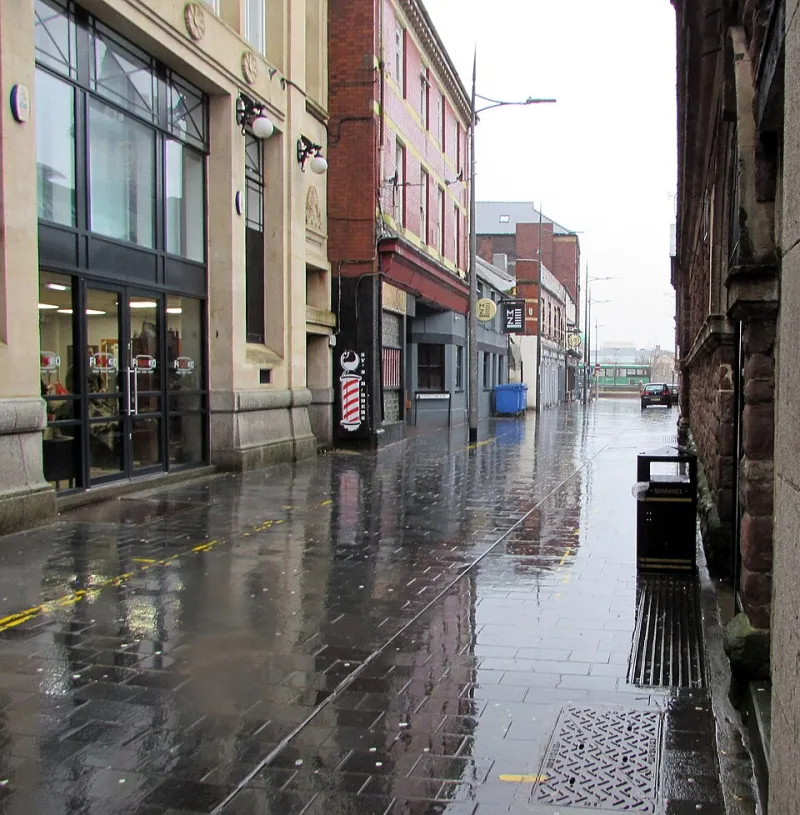
Photo: Jaggery , CC BY-SA 2.0, via Wikimedia Commons
There's a moment every bilingual Brit knows well. You're mid-conversation, chatting away happily in your other language, and then it happens. Someone cracks a joke. Dry, sideways, delivered with a straight face. And you open your mouth to translate it and... nothing comes out.
Not because you've forgotten the words. Because they don't exist.
We spend a lot of time on this site celebrating the beautiful untranslatable words other languages give us — the Danish hygge, the Portuguese saudade, the Japanese tsundoku (buying books you'll never read, a condition every British household knows intimately). But flip the telescope around and something interesting happens: English, apparently so greedy for vocabulary, has its own gaps. And some of the biggest ones are the most British things about us.
The Weather Report Nobody Else Needs
Start with rain. Other languages have rain, obviously. What they don't have is our taxonomy.
Mizzling. Spitting. Drizzling. Pelting it down. Bucketing. That fine grey something that isn't quite fog and isn't quite rain but will absolutely soak your shoulders by the time you've walked to the shop.
"In Polish there's mży — a fine drizzle — but that's roughly where it ends," says Marta, a teacher in Leeds. "My English partner has maybe ten words for rain at different levels of commitment. I have one word and a jumper." She pauses. "Actually, the jumper is the Polish system."
It sounds like a joke about Britain's obsession with weather, and it partly is. But there's something deeper going on. A language builds vocabulary where its speakers need to make distinctions. A nation that lives under constantly changing skies needs to be able to say, precisely, how wet it's about to get before deciding whether to hang the washing out. That's not small talk. That's infrastructure.
The Queue: A Concept With No Passport
Then there's the queue. British English treats queue as a noun, a verb, a moral institution and, occasionally, a national identity. Stand in a line anywhere from A&E to Aldi and you're participating in something that — ask almost any bilingual Brit — simply doesn't translate as a concept.
"In Italian, fila just means a line of things," explains Giuseppe, who runs a café in Glasgow. "When I moved here, someone said 'mind the queue' and I thought it was a person's name. Now I feel genuinely offended when someone pushes in. It took me two years to acquire the emotion, and there was no word for it back home. I had to import the feeling separately."
That's the thing about untranslatable words: the word is often just the visible bit. Underneath it sits a whole social contract. You can't translate queueing etiquette any more than you can translate the embarrassment of saying "you first" four times at a doorway.
Banter: The Word That Eats Jokes
If rain and queueing are the structural gaps, banter is the great black hole. Ask a group of bilingual friends to translate it and you'll get a fascinating range of near-misses: cachondeo in Spanish gets close, jovialité in French gestures at it, German offers... a long pause.
"The problem," says Aisha, a translator in Manchester, "is that banter isn't just teasing. It's teasing that proves affection. The insult is the intimacy. If you translate the words literally, you've just described people being horrible to each other." She's lost count of the times a literal translation has made her English friends sound like bullies and her other-language friends sound like they've no sense of humour at all.
The same trap catches gutted, chuffed, miffed, taking the mick and the entire British art of the understatement. "Not bad" meaning "excellent". "A bit of a problem" meaning "catastrophe". "I've had worse" meaning nothing whatsoever. Try running that through a translation app and watch it produce a sentence no human has ever said.
When the Language Refuses to Cooperate
These awkward moments aren't failures of fluency — they're the seams where two worlds meet, and they're often where the best stories live.
One woman we spoke to described explaining a British wedding to her Turkish grandmother, struggling to convey the concept of the Best Man's speech — a formal tradition of publicly roasting the groom. Her grandmother listened, nodded, and concluded that British people express love through elaborate public insults, which, honestly, isn't the worst summary of banter anyone's produced.
Another described the reverse problem: trying to explain the concept of a sábado barbecue to a Brazilian friend and realising that the word 'barbecue' was doing all the work of an entire social institution with no equivalent backer. "In Portuguese, that gathering has its own gravity," she said. "In English, we just have meat and a garden."
Borrowing Badly
And of course, the traffic runs both ways. English has cheerfully pinched schadenfreude, déjà vu and tsunami while quietly getting them all slightly wrong. Meanwhile, British words abroad tend to arrive wearing the wrong clothes — weekend has been adopted by French speakers as le weekend, which the Académie française regards as roughly equivalent to a burglar leaving muddy footprints.
Perhaps that's the real lesson hiding in these gaps. Languages aren't dictionaries with holes in them. They're maps of what a community cares about — and Britain, it turns out, cares intensely about precise precipitation, orderly waiting, and jokes that mean the opposite of what they say.
So the next time you're stuck translating 'a bit miffed' to a baffled friend, don't reach for the thesaurus. Reach for a cuppa, point out the window at whatever the sky is currently doing — mizzling, probably — and explain that some words aren't definitions. They're invitations. You don't translate them. You join in.