Poetry at 0048 Hours: Why the Shipping Forecast Sounds Like Home Even When It Means Nothing
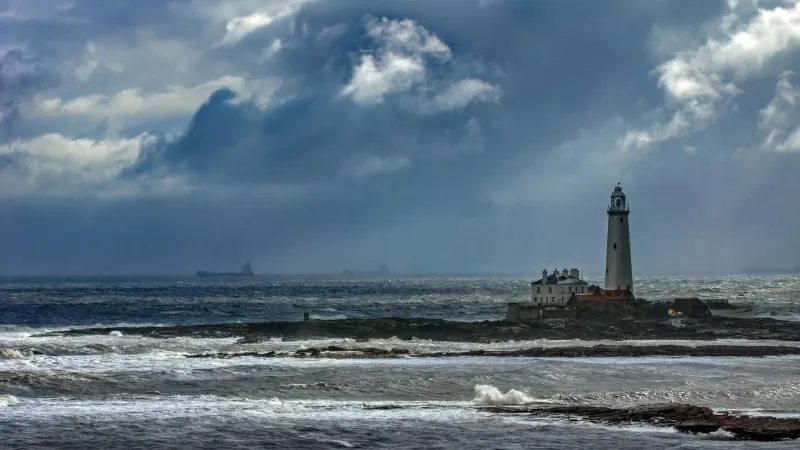
There are poems people study at school, and there are poems people fall asleep to. Britain is unusual in having one that does both jobs at once, broadcast four times a day on the radio, written by meteorologists, and loved by millions who have never set foot on a boat.
The Shipping Forecast shouldn't work. It's a list of wind speeds and sea states. And yet at ten past midnight, when the familiar cadence rolls out of the speakers — Viking, North Utsire, South Utsire — something in the national chest unclenches. Insomniacs swear by it. New parents play recordings of it to newborns. It has been read at the funeral of at least one BBC announcer, at his own request.
So what is actually going on here? Why does a weather bulletin for trawlermen behave like a lullaby — and why has nobody else managed to bottle it?
The Grammar of Calm
Start with the structure, because the structure is doing enormous amounts of work. Every segment follows the same template: area name, wind direction and strength, sea state, weather, then visibility. Good, occasionally, then poor. There are no surprises. There is no room for opinion, or emotion, or even a full sentence in the everyday sense.
That rigidity is the point. In an age where most language is designed to grab you — alerts, notifications, headlines engineered to spike your pulse — the Forecast is a register of speech whose entire purpose is to be perfectly, boringly reliable. It has sounded more or less the same for a century. It will sound the same tomorrow. Listening to it is like holding a handrail.
Then there are the names. Dogger. Fastnet. Malin, Hebrides, Bailey. They are fragments of older maps — sandbanks, lighthouses, headlands — a vocabulary that survived the ships and industries it was invented for. Say them aloud and you're chanting a list of places most listeners will never see. That doesn't matter. The words aren't instructions; they're incantation.
Lost in Translation, Deliberately
Here's the experiment worth running: try explaining the Forecast to someone who didn't grow up with it. Not translating — explaining. Cyclonic, becoming variable three, moderate, occasionally poor. A friend from abroad will nod politely and ask what on earth you're on about.
Translate it properly and it gets worse, not better. The magic isn't in the meaning. It's in the register — that specific lock-up of rhythm, repetition and place-names that no other country's weather bulletin has ever assembled. Other nations have marine forecasts, perfectly good ones. None of them has become a bedtime ritual, a comfort object, a shorthand for safety.
Some have tried. Enthusiasts in Germany and the Netherlands, where coastal radio traditions run deep, have lobbied for similar poetic formats, and French sailors have long had their own bulletins to compare. What they've found is that you can copy the template but not the resonance. The names don't carry the same weight; the cadence doesn't land the same way; the culture hasn't spent decades learning to hear the format as love. A register of language, once it becomes part of how a nation soothes itself, is essentially unexportable.
The Secret Code Effect
There's a second layer, too, and it's more quietly political. The Forecast functions as a kind of membership card. Quote it — Rockall, Malin, Hebrides — and any Brit within earshot knows exactly what you're doing. It's a shibboleth, a low-stakes password, the linguistic equivalent of knowing how to queue.
That's why it shows up where it does: sampled in music, quoted in films, read as a poem at weddings. Blake Morrison and Radiohead's use of it, the countless dance tracks built on samples of Sole, Lundy, Fastnet — none of it requires the listener to care about gales. The Forecast has detached from its function and become pure texture, a sound that means home, night, safety to anyone raised within earshot of Radio 4.
Which tells us something broader about how language actually works in people's lives. We assume meaning is the payload, and everything else is packaging. The Forecast suggests the opposite can be true: a text can matter almost entirely because of how it sounds, when it sounds, and who it makes you feel you belong to.
Keeping Watch Anyway
It would be easy to file all this under nostalgia, but the Forecast still does its original job. Somewhere off the Hebrides tonight, someone on a night watch is listening to the same words for entirely practical reasons. The poetry is a by-product — a happy accident of bureaucratic format meeting ancient place-names meeting the midnight slot.
But the by-product has outlived plenty of things that were meant to be permanent. Languages die, dialects fade, and yet here is a daily bulletin that has become one of the most beloved pieces of continuous writing in Britain, precisely because it never tried to be.
So tonight, wherever you are, the sea areas will be read out in the same calm voice, in the same calm order, and a nation will drift off to a poem it never asked for and would never give up. And that's the end of the shipping forecast.